Lantum
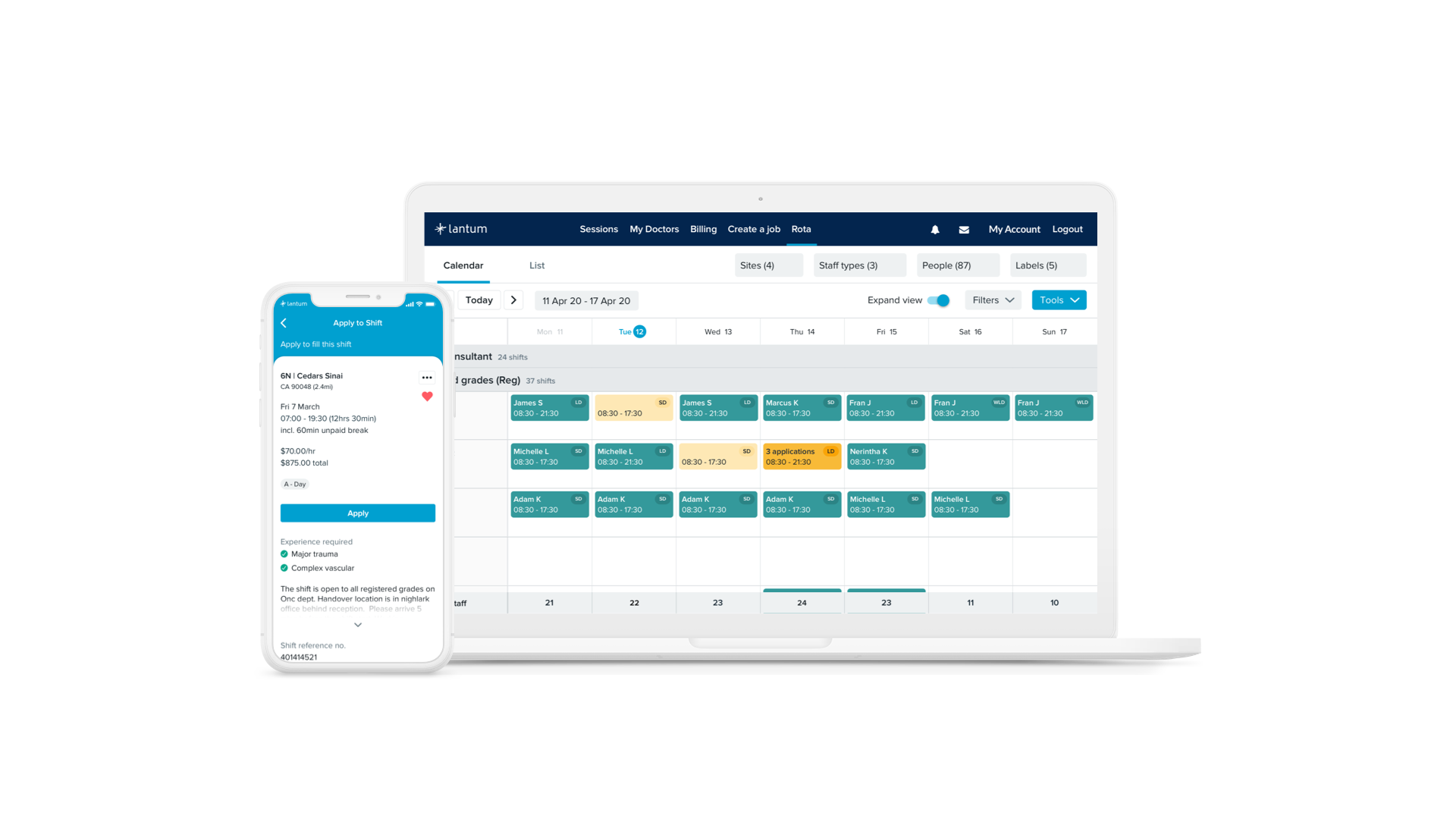
Redesigning how secondary care workers manage their schedules. Rota management time fell by over 50%.
The Problem
Rota management in secondary care settings is a persistent, expensive problem. Two workflows in particular had no good digital solution: shift swapping between workers, and the collection of shift preferences during schedule building.
Shift swapping was being handled informally. Workers would scan the full rota manually, trying to identify colleagues with matching qualifications and availability, then coordinate through unofficial group chats used as ad hoc swap shops. Information shared outside the system is impossible to track, compliance can't be verified, and in practice those groups were routinely misused. The problem wasn't that workers wanted to swap shifts. That's a basic fact of any shift-based workplace. The problem was that the process for doing it properly didn't exist.
Shift preference collection had a similar pattern. In most secondary care settings it was done on paper or through software so outdated it was unreliable. Workers submitted their preferences and then waited, sometimes for days, before seeing them reflected in the rota. The delay created frustration and errors.
Designing the Solutions
Shift Swaps
Research suggested that workers almost always want to swap out of a shift because of an unexpected personal arrangement, not because they're shopping for a better schedule. Starting from that insight, the redesigned workflow inverts the conventional approach.
Rather than asking a worker to search the rota for a suitable partner themselves, the system first asks the worker to identify the shifts they want in exchange. Once those are selected, Lantum's platform surfaces a filtered list of compatible swap partners: colleagues with matching qualifications and genuine availability for the requested shifts.
The worker proposes the swap; if the other party agrees, the request goes to a manager for final approval. All the relevant context (skill-mix, experience, any rule conflicts) is surfaced in a single view so the decision can be made quickly.


Self-Scheduling
For preference collection, the solution was to bring the rules into the workflow itself. Workers are shown available shifts in real time, with scheduling restrictions surfaced as they make selections, turning what had been a slow, error-prone back-and-forth into a single linear process. Mistakes are caught before they're submitted, not after.

Rules Engine
Secondary care organisations run on strict overtime and shift pattern policies, governed by legal frameworks like the European Working Time Directive. Managers are expected to enforce those rules on every scheduling decision, under time pressure and with incomplete information. In practice, rules get missed or deliberately bent to cover staffing gaps.
Lantum's solution was to automate the rule-based decisions entirely. Rather than relying on managers to recall and apply every constraint, a rules engine processes each scheduling action and surfaces any conflicts immediately, so the decision can be made with full context.
Extensive research and stakeholder interviews were used to map every rule and edge case before a line was built. The goal was for the platform to handle the repetitive, rule-bound work that consumed manager time.

Design System
Alongside the feature work, the Lantum design library was rebuilt from scratch. A decade of fast-paced product development without documentation had left the system fragmented: legacy patterns that were outdated, mismatched, or broken. The transition to remote working made the problem impossible to ignore.
The icon library had inherited inconsistent styles from every design direction the product had ever taken, with no coherent visual language. Based on characteristics of the Lantum logo, a set of design guidelines was established to give the icon system a consistent foundation and a clear process for future additions.

The colour system was in a similar state. The inherited palette had no guidance on how colours should be used within the product, resulting in WCAG 2.1 failures across core features. A colour guide was created to ensure every usage met AA standards, followed by a full product audit and adjustment pass.
The component library was rebuilt in Figma as a single source of truth, with design principles documented on Confluence. Identical naming conventions across design and code reduced handoff friction and gave the team a shared language for discussing patterns.


The Result
Together, these features cut rota management time for managers by over 50%. In secondary care, that time is both expensive and badly needed by clinical staff elsewhere.